 EN
EN  FR
FR  US
US  IT
IT  DE
DE  ES
ES  PT
PT  ZH-HANS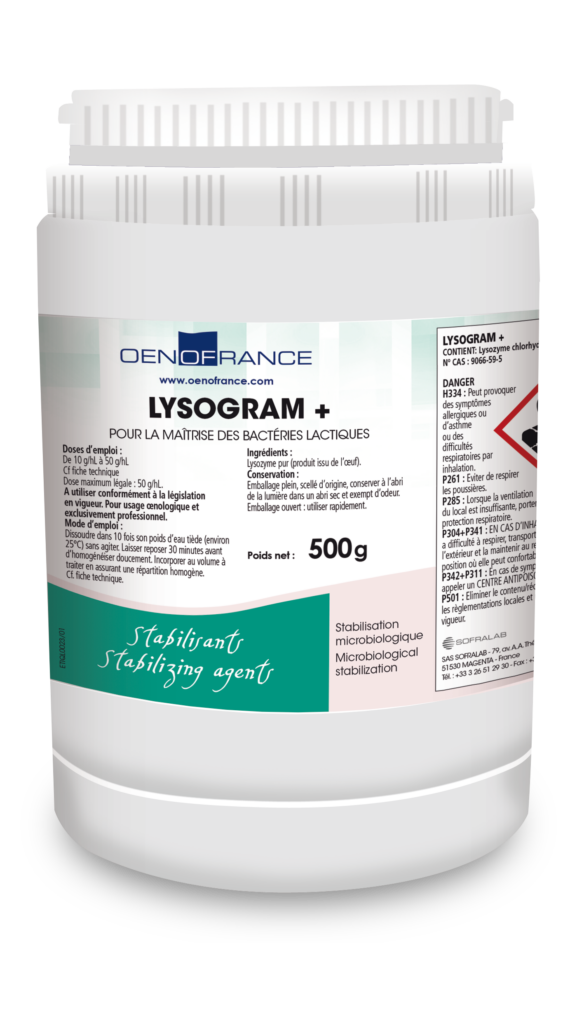


LYSOGRAM+ is a preparation rich in lysozyme, an enzyme whose properties have been highlighted by Alexander Fleming in 1922. Since then, it has been used in bacteriology because it provokes the destruction of the Gram+ bacteria wall, as in lactic bacteria.
- On spoiled must: to limit lactic bacteria proliferation liable to provoke lactic disease.
- During stuck fermentation: to prevent bacterial development while limiting sulfiting, thus optimizing the chances of the incorporated yeasts to end fermentation.
- On wine during fermentation: to control malolactic fermentation and avoid its start before the end of alcoholic fermentation.
- On wine at the end of alcoholic fermentation: to remove the indigenous bacterial flora and delay malolactic fermentation start-up or to stick it.
- LYSOGRAM + does not modify the organoleptic quality of the wine as opposed to SO2.
- LYSOFRAM + allows the reduction of SO2 without replacing it since it does not have any reductive property and is inactive against acetic bacteria and yeasts.


